Hair Removal
Laser hair removal on legs and arms: how the process works across large areas

In short
Legs and arms are large areas, but laser hair removal there is still planned section by section. Sessions are usually spaced 6–8 weeks apart on the arms and 8–10 weeks apart on the legs. Thick, dark hair on the lower legs often responds sooner, while progress is slower with the fine hair on the upper legs and upper arms. A cooled gliding technique, where the handpiece moves across the skin, makes sessions on large areas more comfortable, and since these areas get the most sun in summer, fall is a sensible time to start.
Legs and arms cover the largest area in laser hair removal. Even so, a “full leg” or “full arm” isn't handled as one single zone: the hair on your kneecap is not the same as the hair on your calf. In this post, we divide the legs and arms into smaller sections to show how the process moves forward, why starting in October makes sense, and where the limits of laser lie.
What sets leg and arm laser apart from other areas?
Three things set the legs and arms apart: the size of the area, hair that varies within the same area, and heavy sun exposure in summer. Hair on the lower legs is usually thicker and darker, while on the upper legs, hips, and upper arms it may be finer and sparser. That means even one leg can need different settings. These areas also get months of sun in shorts, skirts, and short sleeves, which directly affects session timing.
How does the process go in each part of the legs and arms?
Sections with thick, dark hair usually respond sooner, and sections with fine hair progress more slowly. Session intervals are set according to the hair growth cycle in each area. The table is a general framework; your personal plan is set at your initial consultation.
| Area | Hair type (general) | Session interval (general) | Note |
|---|---|---|---|
| Lower leg (calf, shin) | Usually thick and dark | 8–10 weeks | Clear response from the first sessions for most people |
| Upper leg and hips | Finer, sometimes sparse | 8–10 weeks | Response may be slower than on the lower leg |
| Knee | Mixed; thick and fine hairs together | 8–10 weeks | Sensation may be stronger because the area is close to bone |
| Tops of feet and toes | Scattered, thick, and dark | 8–10 weeks, along with the legs | Small area, finished quickly |
| Forearm | Medium thickness; darkness varies by person | 6–8 weeks | One of the areas that gets the most summer sun |
| Upper arm | Mostly fine and light | 6–8 weeks | Fine hair is evaluated separately at the consultation |
| Backs of hands and fingers | Scattered and dark | 6–8 weeks, along with the arms | Exposed to the sun all year; protection matters |
On a large area, good planning starts with seeing the leg section by section, not as one piece.
What difference does Soprano Ice Platinum make on large areas?
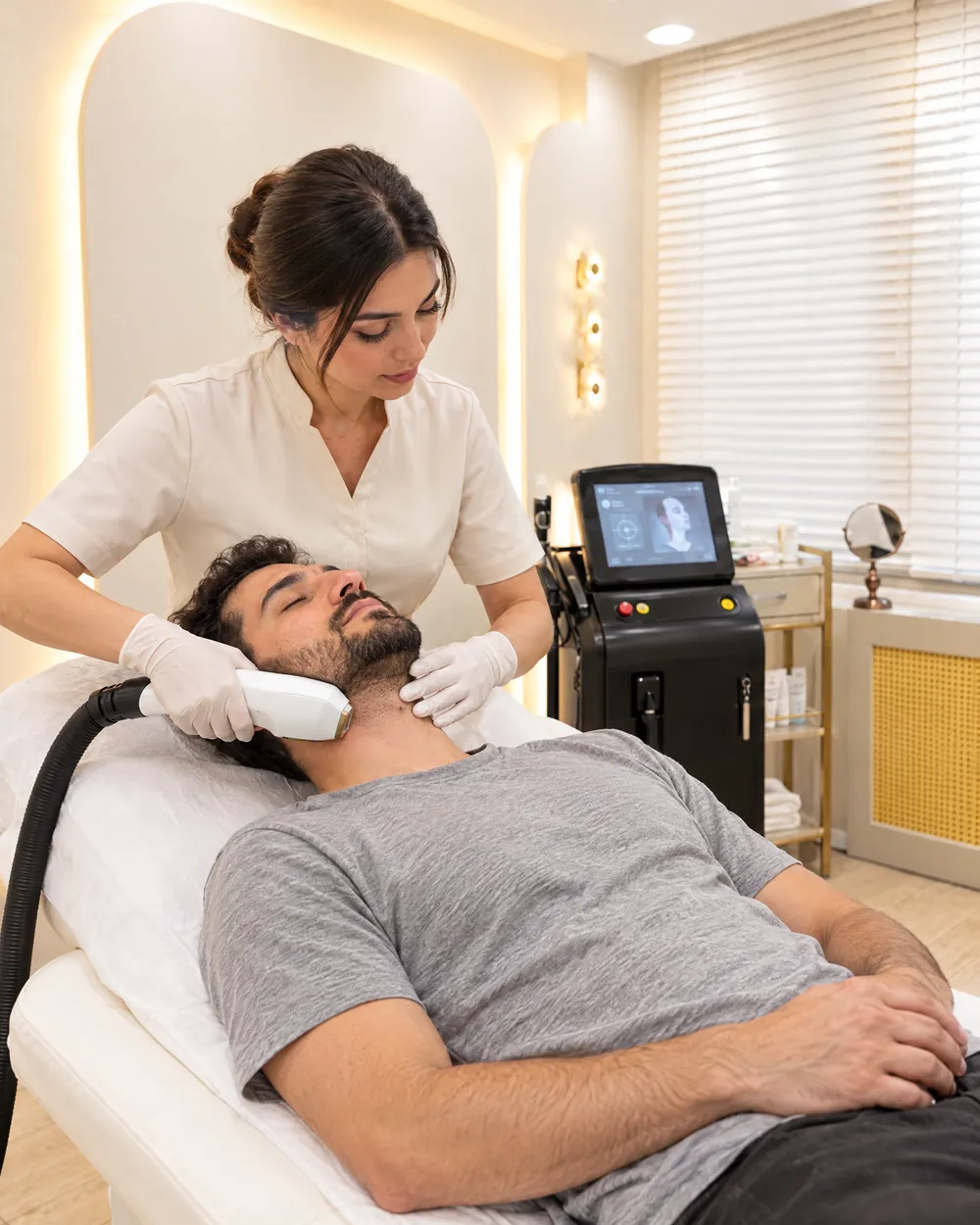
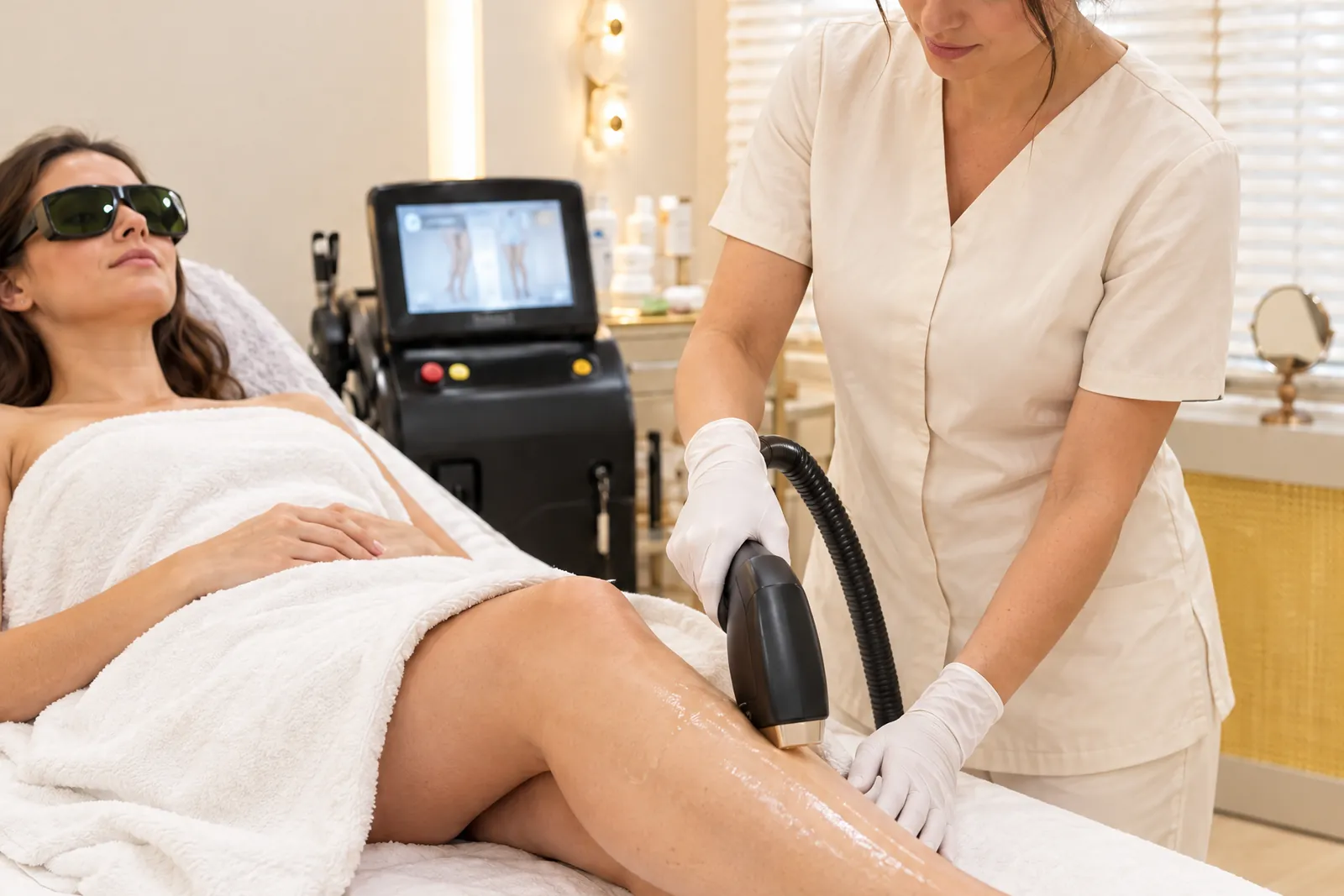
On large areas, the difference comes from the gliding technique and the cooled handpiece. Rather than firing single shots, the handpiece moves continuously over the area. Because energy is delivered gradually, most people describe it as a feeling of mild warmth. Cooling keeps the skin surface cool, so the session is more comfortable and moves relatively quickly. A full leg takes about 30–45 minutes for most people and two arms about 15–20 minutes, depending on the area and hair density.
The device combines 755, 810, and 1064 nm wavelengths in one handpiece, so the thick, deep-rooted hair on the lower legs and the finer hair on the upper legs can be addressed with different settings in the same session.
Why is fall a sensible time to start laser?
Fall makes sense because the legs and arms get the most sun in summer, and a plan started in October or November gets through the first sessions without the pressure of sun exposure. As your summer tan fades, the color contrast between skin and hair becomes clearer, and longer clothes make it easier to protect your skin from the sun after each session.
A leg plan started in October leaves room for four or five sessions before summer at 8–10 week intervals. Arm intervals are shorter, so that number is slightly higher. This doesn't mean the process will be finished by summer; it only means part of the plan falls in the months with the least sun. At our center, sessions can continue in all four seasons, so you can keep going in summer too, with stricter sun rules. We cover those rules in detail in our blog post on laser hair removal in summer.
How do you switch to laser after years of waxing?
The first step is to stop waxing. From then on, use only a razor between sessions. Waxing pulls hair out by the root, which removes the root the laser needs to target. If you have waxed for years, shaving may feel strange in the first weeks. You will feel hair sooner, but that shows the root is in place.
- Share the date of your last wax at your consultation. We usually wait 3–4 weeks before the first session so the hair can grow back to the surface.
- During this time, stop waxing, tweezing, and using an epilator completely. If needed, use only a razor.
- Shave the area with a razor the day before your first session.
- In the early sessions, hair may thin at different speeds from one section to the next. In areas waxed for a long time, hair may already be finer.
- When you switch to shaving, shave in the direction of hair growth with a sharp blade, and take care around the bony parts of your knees and ankles.
Does laser work on fine arm hair and light-colored hair?
Laser has a limited effect on very fine, light-colored hair. This type of hair, found on the upper arms and parts of the forearms, has little pigment in the root, so the laser may not find enough of a target. In rare cases, very fine hair can become more noticeable after a session, so we evaluate these areas separately at the consultation and limit sessions to the areas where we expect results.
Laser does not work on white, gray, or very pale blond hair. It targets dark pigment in the root, so hair without pigment gives it nothing to work on. This limit applies to every device. We don't plan sessions for this hair, and we tell you so clearly at the consultation.
What happens in areas with tattoos, moles, or visible veins?
In these areas, we either narrow the session area or evaluate first. Laser is not applied over tattoos. Tattoo ink can also absorb the energy, so the handpiece is used around the tattoo, leaving some distance. Dark, raised moles are protected during the session and not passed over. If your legs have prominent, raised veins or the look of varicose veins, we first assess the area together, and if needed, we ask you to get a doctor's opinion before the session.
How is arm and leg laser planned for men?
For men, arms and legs can also be planned with thinning as the goal, not complete clearing. Many men want a less dense look, not hairless skin. Once that goal is clear at the consultation, the plan is built around it.
Athletes tend to have more practical reasons. Cyclists point to easier wound care after a fall and easier massage, swimmers to the feel in the water and easier upkeep, and runners to less friction from tape and tights.
How should you care for your legs and arms between sessions?
Between sessions, protect your legs and arms from sun and heat, and keep your skin moisturized:
- Sun: Keep the area out of direct sun for at least two weeks. The arm on the window side when you drive and the tops of your feet in sandals are the spots people forget most. Use SPF 50 on exposed areas.
- Hot showers and saunas: For the first 48 hours, avoid hot showers, saunas, hammams, and pools. A short, lukewarm shower is enough.
- Exercise: For the first 48 hours, skip workouts that make you sweat heavily, and choose loose cotton clothing over tight leggings and snug arm bands.
- Moisturizing: Legs dry out quickly from indoor heating in fall and winter. Keep up regular care with a plain, fragrance-free moisturizer.
What are the common misconceptions about leg and arm laser?
- “You can't do leg laser in summer.” If you follow the sun rules, leg and arm sessions can continue in summer. The decision is made at each session based on your skin's condition that day.
- “You can keep waxing alongside it.” Waxing pulls out the root the laser targets, so it lowers the efficiency of your sessions. Throughout the process, use only a razor.
- “One session is enough for arms.” Arm hair is also at different growth stages, and a single session only targets the hair that is active that day.
- “The more sessions, the better.” Shortening intervals or adding sessions for hair that doesn't respond doesn't improve results. The number of sessions depends on how your hair responds.
When should you talk to a doctor?
The following situations need a doctor's evaluation, not a care center's. We recommend talking to your doctor before starting a laser plan.
- You notice a clear increase in hair on your arms or legs in a short time.
- Increased hair growth comes with irregular periods, which calls for a hormonal evaluation.
- Redness after a session doesn't fade within a few days, or blisters form in the area.
- A mole on your legs or arms has changed shape, color, or size.
At our center in Nişantaşı, we build your leg and arm plan together after examining your hair section by section at the consultation. Vega Beauty is a beauty and care center. If we notice anything during your sessions that calls for a medical evaluation, we refer you to a dermatologist or the appropriate doctor.
Frequently asked questions
How many sessions does leg laser take?
For most people, a general framework is 6–8 sessions on the legs, spaced 8–10 weeks apart. Thick, dark hair on the lower legs usually responds sooner, while the upper legs can take a little longer. We share a personal estimate after examining your hair at the consultation.
Can arms and legs be done in the same session?
Yes, both areas can be scheduled on the same day; the session just takes longer. The general interval is 6–8 weeks for arms and 8–10 weeks for legs, so a shared schedule of about 8 weeks, where the two ranges meet, is possible. We work out the right schedule together at your consultation.
Is laser used on hair on the toes and fingers?
Hair on the toes and fingers is often scattered, thick, and dark, so it usually responds well to laser. These areas are small, so they can be added to a leg or arm session and finished quickly. On the first day after a session, choosing comfortable shoes over tight, closed ones reduces friction.
If I start in fall, will I need to pause sessions in summer?
Usually not. If you can follow the sun rules, sessions continue through the summer months. A session that falls during a vacation or a period of heavy sun can be moved by a few weeks. That adds a few weeks to your plan, but it doesn't cancel out the sessions you have already done.
Are small bumps around the hair follicles normal after a session?
Yes. Mild redness and small bumps around the follicles are an expected reaction, and for most people they ease within a few hours. Keeping the area cool and avoiding tight clothing helps. If redness lasts longer than 2–3 days or you notice blistering, let us know.
Can I use self-tanner on my legs?
Self-tanning creams and sprays darken the skin's surface, so don't use them before a session; wait until the product has completely left your skin. If you plan to use them between sessions, mention it at your consultation and we will time your next session accordingly.
Published: · Vega Beauty editorial team. This article is general information and does not replace a medical diagnosis or advice; whether a service suits you is assessed at your consultation.