Hair Removal
Laser hair removal on the face: what to know about the upper lip, chin, and sideburns
In short
The face is the area people ask about most in laser hair removal, and the one that calls for the most expectation management. Dark, coarse hair usually responds well to laser, while on fine, light hair and peach fuzz the effect may be limited. The chin area is sensitive to hormonal changes, and a sudden increase in hair calls for a doctor's evaluation first. We tell you plainly at the consultation which hairs laser can't target.
A few dark hairs above the lip, coarse hairs under the chin that come back every week, fine hair on the sideburns that shows through makeup… The face may be a small area, but it's the one we get the most questions about in laser hair removal. In this post we explain how laser hair removal on the face is planned and why honest expectation management comes before everything else here.
Why is laser hair removal on the face different from other areas?
The face is where hair types are most mixed. Dark, coarse hairs, fine light hairs, and nearly invisible peach fuzz can all exist on the same face. Because laser works by targeting the pigment in the hair root, dark, coarse hair responds better, while fine, light hair may not show the same effect.
The face is also one of the areas most sensitive to hormonal changes. On the legs or underarms, hair density usually drops steadily as sessions go on, while on the face, new hairs appearing from time to time is more common. That doesn't mean laser “isn't working.” It means hair on the face behaves differently.
What approach is used for each area of the face?
| Area | Common hair type | General approach |
|---|---|---|
| Upper lip | Mostly fine, sometimes dark hairs | Laser for dark hairs; expectations for fine, light hairs are discussed at the consultation |
| Chin and under the chin | Coarse, dark hairs that grow one by one | Usually responds well to laser; with a sudden increase, a doctor's evaluation comes first |
| Sideburns and cheeks | Fine, light hairs | Laser's effect may be limited; hairs that can be targeted are identified at the consultation |
| Between the brows | Dark, coarse hairs | Careful session with eye protection; brows are not shaped with laser |
| Neck | Mixed hair types | Planned by hair color; laser's limit on light hairs is discussed plainly |
Does laser work on fine, light hair?
On fine, light hair, laser's effect may be limited. This comes from how laser works, whatever the device. Because laser targets the dark pigment in the hair root, it can't find enough of a target in blond, red, gray, or white hairs with little pigment. By combining different wavelengths, Soprano Ice Platinum allows controlled sessions on many hair types, but no laser can target a hair with no pigment.
That's why we look at your hair together at the consultation and give you an honest picture: which hairs can be expected to respond to laser, and which can't. For some of our clients, the right decision is no laser on the face at all.
Why does hair increase on the chin?
The chin and the area under it are among the most exposed to the effects of hormones. Hair density here can increase with age, hormonal phases, or certain health conditions. This area often responds well to laser, but if an underlying hormonal factor continues, new hairs may keep appearing.
If you notice any of the following, we recommend talking to a gynecologist or endocrinologist before starting a laser plan:
- Hair that increases and thickens noticeably in a short time.
- Increased hair growth along with irregular periods.
- Hair growth accompanied by stubborn acne or thinning scalp hair.
- Dark, coarse hair starting to appear in areas that never had it before.
A doctor's evaluation isn't an obstacle to laser. It actually helps us plan more realistically. Knowing the underlying cause lets us speak more clearly about how many sessions may be needed and how often to plan maintenance sessions afterward.
What can be done about hairs laser can't target?
It isn't realistic to expect results from laser on light, white, or gray hairs; sessions on these hairs would only waste your time and effort. So at the consultation we separate the hairs laser can target from those it can't and limit sessions to areas where results can be expected. For nearly invisible fine hair, the right decision is usually to do nothing at all.
If a few visible light hairs bother you, we talk about them openly at the consultation. We'd rather give you a realistic picture than promise a result laser can't deliver. If the increase in hair goes along with a hormonal picture, a doctor's evaluation comes first.
How do session intervals and the process work on the face?
Session intervals on the face are usually shorter than on the body, planned 4–6 weeks apart for most people. That's because facial hair has a faster growth cycle. The number of sessions varies from person to person according to hair type, hormonal makeup, and area, and on the face it's also common to need maintenance sessions at set intervals after the first series.
- At the consultation, your hair type, skin tone, and hormonal history are assessed.
- We decide together which hairs will be targeted and which areas will be left alone.
- Before the first session, the area is shaved with a razor the day before.
- Sessions continue 4–6 weeks apart; between them, use only a razor.
- After the first series, maintenance sessions are planned according to any new hair growth.
How is laser on the face planned for dark skin?
For dark and olive skin tones, laser on the face can be planned with a suitable wavelength and careful energy settings. Because this skin has more pigment at the surface too, it's important that the laser's energy goes to the hair root and not into the skin. The Nd:YAG wavelength in Soprano Ice Platinum reaches deeper and is less affected by surface pigment, which contributes to a more controlled session on dark skin.
Because the face gets sun and tends toward dark spots, it's often a good step with darker skin to do a test shot on a small area before the first session and watch the skin's response for a few days. If your face is prone to pigmentation, be sure to mention it at the consultation.
How is laser used on men's faces?
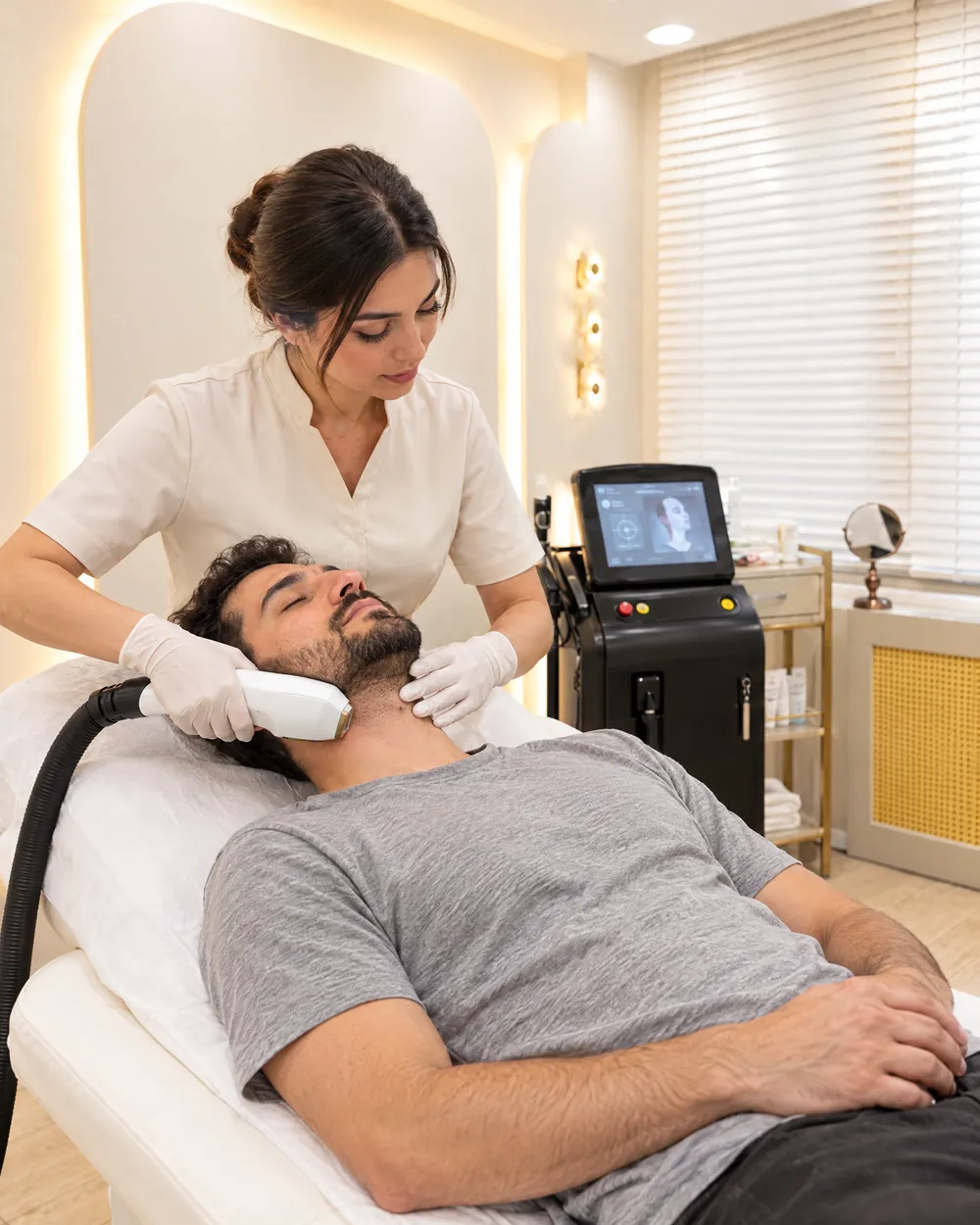
For men, laser on the face is usually meant to shape the beard line: the upper cheeks, neck, and nape line are the most requested areas. Beard hair is coarse and dark, so it usually responds well to laser, but it's important to target only the unwanted line, not the whole beard. That's why the boundaries are set together and marked before the session. Laser on the neck is also a common choice for men who get ingrown hairs from frequent shaving.
What should you keep in mind for your face before and after a session?
The face gets more sun and more active products than any other area, so the rules before and after a session matter especially here.
- Keep your face out of the sun and stay away from tanning beds for two weeks before your session.
- Stop retinol, acid products, and peels a few days before your session, and we'll decide together when to restart them.
- Between sessions, don't wax, thread, tweeze, or use an epilator; any method that pulls out the root removes laser's target.
- Come to your session with no makeup or cream on your face.
- For the first 24–48 hours after your session, avoid makeup, hot showers, saunas, and intense exercise.
- Use a broad-spectrum sunscreen on your face every day, even on cloudy days.
A good laser process on the face starts with knowing which hairs to leave alone.
What are the common misconceptions about laser hair removal on the face?
- “Laser on your face will make you grow a beard.” On dark, coarse hair, laser reduces hair density; the rare cases of hair becoming more noticeable have been reported with fine peach fuzz. That's why we don't recommend sessions on fine hair.
- “Laser can shape your eyebrows.” The area between the brows can be cleared, but brows aren't shaped with laser, because hair removed that way can't be brought back later.
- “Laser gets rid of white hairs too.” Hairs with no pigment can't be targeted by laser, and we say so plainly at the consultation.
- “Once sessions are over, no hair will ever grow on your face again.” The face is open to hormonal effects, and maintenance sessions may be needed over time.
At our center in Nişantaşı, the consultation for the face includes a close look at your hair and a plain talk about the most suitable method and realistic expectations. Vega Beauty is a beauty and care center; when a hormonal or medical evaluation is needed, we refer you to the relevant doctor.
Frequently asked questions
Can laser hair removal be done on the upper lip?
Yes, dark hairs on the upper lip usually respond well to laser. Because the hair here is often fine and light, we assess together at the consultation which hairs can be targeted. On very fine, light hairs, laser's effect may be limited.
How many laser sessions does the face take?
The number of sessions varies with hair type, hair color, and hormonal makeup. Sessions on the face are usually 4–6 weeks apart, and maintenance sessions may be needed at set intervals after the first series. We'll share an estimate for you after looking at your hair at the consultation.
Will laser completely get rid of chin hair?
On dark chin hair, laser aims to noticeably reduce density, but because this area is sensitive to hormones, new hairs may appear over time. If there's a sudden, noticeable increase, we recommend talking to a doctor first.
What can be done about blond, fine hair on the face?
Laser may not find enough of a target in blond, fine hair with little pigment, so we don't recommend sessions for this hair. For nearly invisible peach fuzz, doing nothing is usually the right decision.
Can I wear makeup after laser on my face?
We recommend skipping makeup for the first 24–48 hours after a session, since your skin may be sensitive during this time. After that, you can go back to your routine with gentle products. Keep using sunscreen every day.
Can I get facial hair threaded before laser?
Threading, waxing, and tweezers are not used between sessions because they pull out the root and remove laser's target. Between sessions, we recommend using only a razor.
Published: · Vega Beauty editorial team. This article is general information and does not replace a medical diagnosis or advice; whether a service suits you is assessed at your consultation.