Hair Removal
Laser hair removal for men: a guide to the back, chest, and beard line

In short
Laser hair removal for men aims to reduce hair density on the back, chest, shoulders, nape, and beard line and create a tidier look. Because men's hair is usually thicker and denser, most men plan for 8–12 sessions. On the beard line, the border is set carefully, together with you, before the session.
Laser hair removal was long seen as something for women; today it has become a regular part of many men's grooming routines. Dense hair on the back, a neck that turns red after shaving, an uneven nape line, and the sweat and friction that come with working out are among the most common everyday reasons men come to it. This guide covers what you need to know, area by area.
How does laser hair removal differ for men?
Laser hair removal for men calls for different planning because men's hair is thicker, darker, and denser. Under the influence of testosterone, hair roots are stronger and deeper. This can bring a clear response in the first sessions, but it may also mean the total number of sessions runs a little longer.
- Hair density: there are usually more hairs per unit of area on the back and chest.
- Hair thickness: thick hair absorbs laser energy more strongly, which can create a more intense feeling of heat during the session.
- Area size: large areas such as the back and chest make sessions longer.
- Hormonal effects: new hair can appear over the years, especially on the shoulders and upper back, which is why maintenance sessions matter.
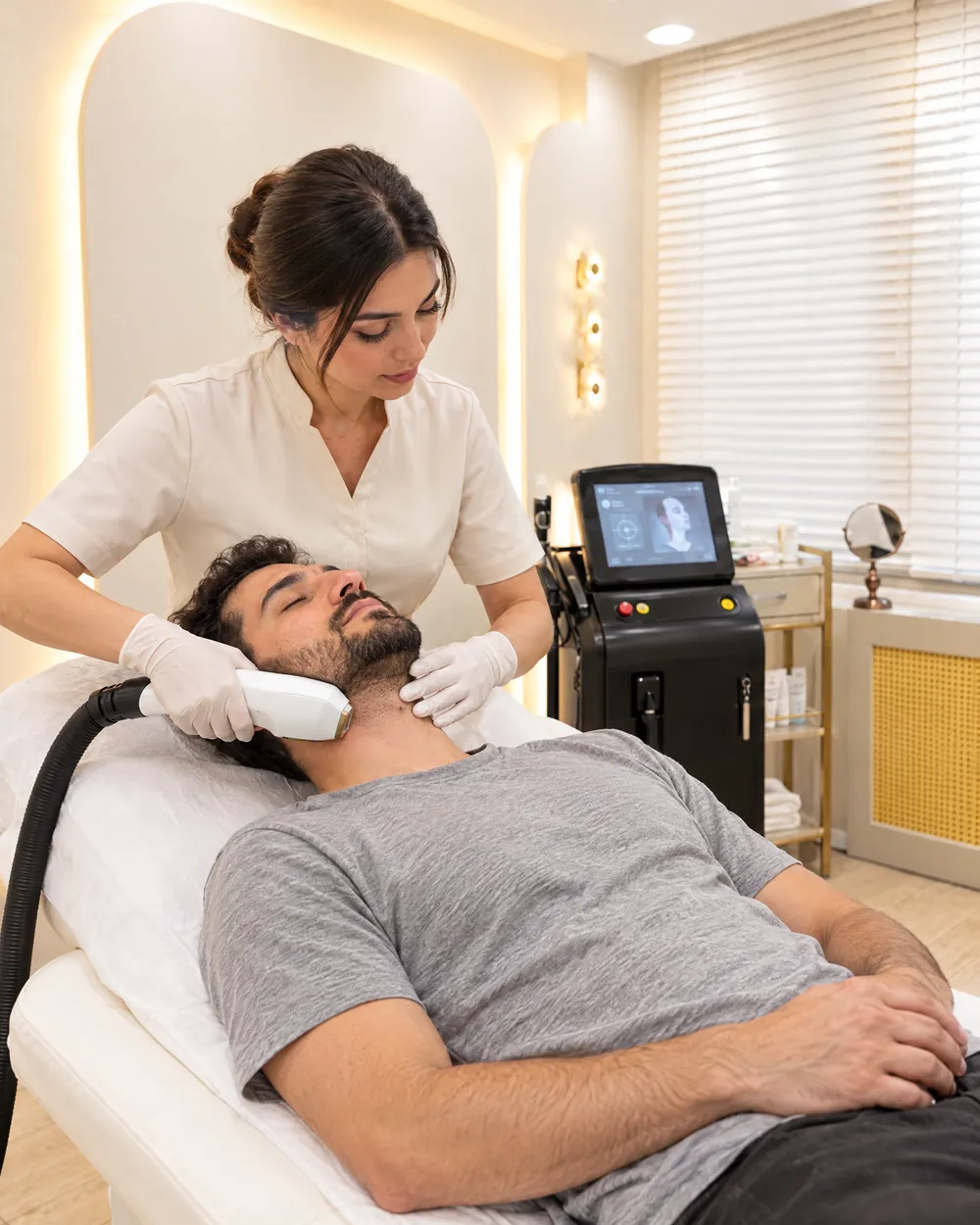
Soprano Ice Platinum combines Alexandrite (755 nm), diode (810 nm), and Nd:YAG (1064 nm) wavelengths in a single head. Being able to reach hair roots at different depths at the same time is an advantage, especially with thick, deep-rooted male hair. The cooled head also helps sessions on large areas stay comfortable.
How are sessions planned for the back, chest, and shoulders?
Laser hair removal on the back, chest, and shoulders is usually planned at 6–8 week intervals, with 8–12 sessions for most men. These areas are large, so sessions take longer; the back and shoulders together can average 30–45 minutes.
For most men, back hair is in a spot that's hard to shave alone. The area has to be shaved before your session, so if that's a problem for you, just mention it when you book and we'll plan the preparation together. For the chest and abdomen, it's important to discuss at your consultation whether you want a completely smooth look or simply less density.
| Area | Session interval (usually) | What to keep in mind |
|---|---|---|
| Back | 6–8 weeks | You may need help shaving; large area, long session |
| Shoulders | 6–8 weeks | Hormones can bring new hair; maintenance matters |
| Chest and abdomen | 6–8 weeks | Decide at the start whether you want full clearing or thinning |
| Nape | 4–6 weeks | The hairline border must be set carefully |
| Beard line (upper cheeks, neck) | 4–6 weeks | The beard border must be drawn before the session |
| Arms and backs of the hands | 6–8 weeks | Sun-exposed area; sun protection is essential |
Can laser be used on the beard line, and how is the border set?
Yes, laser hair removal can be done on the beard line, but on the stray hair outside the beard that makes it look uneven, not on the beard itself. The upper cheeks, the area around the cheekbones, and the neck are the most commonly chosen areas. The most critical step is setting the border carefully, together with you, before the session.
- At your consultation, we talk about how you wear your beard and whether you might change your style in the future.
- The beard border is marked with you at the mirror, in a way that suits your facial features.
- The symmetry of the border is checked on both cheeks and on the neck.
- In the first sessions, we stay slightly outside the border and move cautiously.
- In later sessions, depending on the result, the border is refined with your approval.
Keep in mind that beard line laser is a hard decision to reverse. You may like a short, sharp-edged beard today, but in a few years you might want a fuller one. That's why leaving some flexibility when drawing the border is the wiser approach for most men.
What are the benefits of laser on the nape and neck?
Laser hair removal on the nape and neck helps the hairline look tidier and contributes to less redness after shaving and fewer ingrown hairs. Men who wear their hair short in particular often need frequent barber visits for uneven hair along the nape; laser aims to reduce that need.
Frequent shaving on the neck can lead to irritation at the hair roots and ingrown hairs. Because laser hair removal reduces hair density and with it the need to shave, it may help ease sensitivity in this area. If you have dense bumps on your neck that look inflamed, we recommend seeing a dermatologist before your session.
How should active men plan their sessions?
If you exercise regularly, plan your sessions around your training program, because you'll need to stay away from intense exercise, saunas, and pools for the first 48 hours after a session. Sweat and friction can increase redness on skin that's sensitive after laser.
- If possible, schedule your session for the day before a rest day or on one of your lighter training days.
- For 48 hours after a session, take a break from exercise that makes you sweat heavily, such as weight training, running, and cardio.
- Wait at least 48 hours before going into a chlorinated pool or the sea.
- If you run or cycle outdoors, apply SPF 50 to the exposed areas that had the session.
- For the first few days, choose loose cotton clothes over tight synthetic sportswear.
- Share important dates such as competitions, matches, or bodybuilding shows at your consultation.
For men involved in sports such as bodybuilding or swimming, planning gets easier once you set a date for finishing the process. Given the number of sessions and the intervals between them, if you want to be ready by a specific date, we recommend starting at least 8–10 months ahead.
What should men keep in mind before and after a session?
The most important rule before a session is to shave the area 12–24 hours ahead and avoid any method that pulls hair out at the root. For the beard line, shaving on the morning of your session is usually enough, but don't apply cologne, alcohol-based lotion, or scented balm afterward. These products can make your skin more sensitive before laser.
For the first 24–48 hours after a session, you may see mild redness in the area and small bumps around the hair roots. On the beard line, we recommend not shaving during this time and letting your skin rest. On the back and chest, wearing loose cotton clothing instead of tight synthetic fabrics reduces friction. The areas covered in your session should be protected from the sun for at least two weeks.
Within 10–20 days after a session, you'll see the hairs shed on their own. During this time, don't pull them out; supporting the shedding with a gentle exfoliating glove is enough. If you need to remove hair between sessions, use only a razor or a trimmer that leaves it short. If you're prone to ingrown hairs, especially on the neck, shaving less often also helps your skin feel more comfortable.
What are the common misconceptions about laser hair removal for men?
The most common misconception is that men's hair doesn't respond to laser. In fact, dark, thick hair is the type that absorbs laser energy most efficiently. Other frequent misunderstandings:
- “Hair grows back more often after laser.” Laser aims to reduce hair density. In very rare cases, a different response can occur in fine hair, and this is monitored across sessions.
- “Back hair is gone after one session.” Because of the hair cycle, each session targets only the hairs in the growth phase.
- “You could lose your whole beard by accident.” The border is drawn together with you before the session, and the head is used only within the marked area.
- “Laser is only for before summer.” If you follow the sun rules, sessions can be planned year-round.
For men, laser hair removal is less a choice about appearance than a comfort decision that cuts down on the small annoyances that start with shaving every morning.
Men's expectations can also vary quite a bit. Some want a completely smooth back, some just want thinner chest hair, and others only want a tidy nape line. That's why the first conversation should focus less on “how little hair” and more on “what kind of look.” Getting your expectations clear at the start helps set the right session plan and area, and means fewer surprises along the way.
How does laser hair removal for men work at Vega Beauty?
At Vega Beauty, the process begins with an initial consultation where we assess your hair type and skin tone. We talk about which areas you'd like covered, the look you expect on your beard line, and your training or work calendar, and create a personal plan. At our center in Nişantaşı, every session takes place in a private room, which helps you feel at ease, especially for back and chest sessions. If we see an unexpected skin reaction during your sessions, we'll refer you to a dermatologist.
Frequently asked questions
How many laser hair removal sessions do men need?
Because men's hair is usually thicker and denser, most men plan for 8–12 sessions. Sessions are spaced 6–8 weeks apart on large areas such as the back, chest, and shoulders, and 4–6 weeks apart on the face and nape. Rather than a fixed number, we share a personal estimate at your consultation and update it as your sessions progress.
I can't shave my own back. What should I do?
This comes up all the time. Just mention that you can't shave your back when you book, and we'll plan the preparation together before your session. What matters is that the hair isn't pulled out at the root, which means no waxing or epilators. If you've used anything other than shaving, be sure to tell us before your session.
Will beard line laser damage my beard?
Beard line sessions are done only in the area marked together with you; the head isn't used on the beard itself. In the first sessions, we stay slightly outside the border and move cautiously. After we review the result together, the border is refined with your approval. This step-by-step approach helps reduce the risk of an unwanted change.
When can I work out after laser hair removal?
For the first 48 hours after a session, we recommend staying away from exercise that makes you sweat heavily, as well as saunas, hammams, and pools. A light walk usually causes no problems. Since sweat and friction can increase redness on skin that's sensitive after laser, it helps to schedule sessions on the lighter days of your training program.
Does laser hair removal hurt for men?
The sensation varies from person to person; most describe it as a brief feeling of heat or a mild prick on the skin. It can be a little stronger in areas with thick hair. The cooled head of the Soprano Ice Platinum keeps the skin's surface cool and adds to your comfort. If you tell us how it feels during the session, the settings are reviewed accordingly.
Can hair come back on the shoulders years later?
The shoulders and upper back are hormone-sensitive areas, and in some men new hair roots can become active with age. In that case, one or two maintenance sessions a year can be planned. If you notice a clear increase in hair over a short time, we suggest seeing a doctor to assess the cause.
Published: · Vega Beauty editorial team. This article is general information and does not replace a medical diagnosis or advice; whether a service suits you is assessed at your consultation.