Body & Contouring
Why do your legs feel heavy by evening? The role of desk work, long flights, and high heels

In short
Heaviness and mild swelling in the legs at the end of the day usually come from staying in one position for too long. Calf muscles that aren't working do less to move fluid back up, and salt, heat, and high heels can make the feeling stronger. A few minutes of movement during the day and raising your legs in the evening make a difference for most people. Massage supports a feeling of lightness, but it doesn't remove the cause. Sudden swelling in one leg, pain, redness, or shortness of breath is a matter for a doctor.
Shoes that fit comfortably in the morning feel tight by evening, your socks leave a ring on your calves, and the first thing you want to do at home is put your legs up. That is the picture many of our clients describe, whether they work at a desk, stand all day, or fly often. Most of the time this feeling is harmless and closely tied to your daily routine. In this post, we explain where evening heaviness comes from, what you can do during the day, and where massage fits in. Please don't skip the section on seeing a doctor at the end.
Where does the heavy feeling in your legs come from in the evening?
When you stand or sit, gravity makes it easier for blood and tissue fluid to settle toward your legs. Your calf muscles play a large part in moving that fluid back up toward the heart. With every step, the calf muscles contract and squeeze the veins, working like a pump, while small valves inside the veins keep blood from slipping back down. The lymphatic system has no pump of its own; it also depends largely on muscle movement and breathing.
When you sit without moving for hours, or stand in one spot, this pump slows down. Over the day, a little more fluid collects in the lower legs and around the ankles. The result is the heaviness, tightness, and mild puffiness you notice in the evening. This kind of swelling is usually similar in both legs, goes down a good deal overnight with rest, and feels more like fullness than pain.
Which daily habits make the feeling worse?
Heaviness usually builds from several factors that stack up over the same day. See which ones stand out in your own day.
| Habit | Effect on your legs | A small change |
|---|---|---|
| Sitting at a desk for hours | The calf muscle stays idle and the knees stay bent for a long time | Getting up for a few minutes every hour and moving your ankles while seated |
| Standing in one place for a long time | Standing is not walking; the muscle pump still does little work | Shifting your weight from foot to foot and rising onto your toes |
| Long flights and long drives | Hours of sitting still in a tight space | Getting up to walk now and then, foot movements in your seat |
| High heels all day | The ankle stays fixed and the calf muscle can't work fully | Flat shoes for the commute, taking your shoes off to stretch during the day |
| Salty and processed foods | Can increase water retention | Cutting back on ready-made sauces, chips, and deli meats |
| Drinking little water during the day | Can strain your fluid balance | Spreading water across the day, keeping water on your desk |
| Hot rooms, hot baths, sauna | Heat widens the blood vessels, and heaviness can increase | Ending your shower with cool water on your legs |
There are seasonal and cyclical factors too. Many women feel more fullness in their legs in the days before their period, and in winter, walking less in the cold can have a similar effect.
If you work at a desk, what can you do during the day?
Small movements you can do without disrupting your work keep the calf pump going. What matters is not intensity but spreading movement across the day; a break of a few minutes every hour is a realistic goal for most people.
- Ankle pumps: While seated, keep your heels on the floor and lift your toes, then press your toes down and lift your heels. Repeat this rhythmically a few times.
- Ankle circles: Lift your foot slightly off the floor and slowly rotate your ankle in both directions.
- Calf raises: While standing, hold on to a desk or wall, rise onto your toes, and lower yourself slowly.
- Short walks: Take phone calls standing up and walking, and use a flight or two of stairs instead of the elevator.
- Give yourself a reason to get up: Keep a small glass on your desk instead of a large bottle, so refilling it becomes a natural break.
- Don't sit with your legs crossed for long: Change position often and keep your feet flat on the floor.
How can you keep your legs comfortable on long flights and long trips?
A long flight is one of the most sedentary situations there is: a narrow seat, bent knees, and hours in the same position. A few simple steps can help your legs feel lighter when you land.
- Choose an aisle seat if you can; it makes getting up to walk easier.
- While you're awake, get up now and then and take a short walk down the aisle.
- Repeat ankle pumps and ankle circles regularly while seated.
- Wear comfortable clothes that don't pinch at the waist or ankles, and loosen your shoes.
- Drink water throughout the trip, and limit alcohol and salty snacks.
If you have a history of blood clots, recent surgery, a pregnancy, or take medication containing hormones, talk to your doctor before a long flight. If you are considering compression socks, ask your doctor or pharmacist about the right pressure and size.
How do high heels affect heavy legs?
In high heels, your ankle stays in a raised position the whole time. As you walk, the calf muscle can't contract and relax through its full length, which means the muscle pump works less efficiently. That is why someone who wears heels all day may notice more calf tightness, fuller ankles, and tiredness by evening.
This doesn't mean you have to give up heels. Wearing flats for the commute and saving heels for the office or an event, slipping your shoes off to rotate your ankles when you can, and gently stretching your calves in the evening all lighten the load.
Why do hot weather and hot water make your legs feel heavier?
Heat causes the vessels near the surface to widen so the body can cool down; blood returns a little more slowly, and your legs can feel fuller. That is why heaviness is more noticeable in summer and after a hot bath or a sauna.
Something similar can happen in winter: sitting for hours right next to a radiator or heater, or taking long, very hot showers, can create the same fullness in your legs. Don't point a heater directly at your legs, and ending your shower with cool water on your legs, moving from the ankles upward, feels refreshing to many people.
Does raising your legs really help?
Yes, it's one of the simplest and most accessible ways to ease evening heaviness. When your legs are above the level of your heart, gravity helps fluid return upward instead. At the end of the day, lying on your back for 10 to 15 minutes with your legs raised on pillows or resting against a wall gives most people a feeling of lightness.
What does lymphatic drainage massage do here, and what doesn't it do?
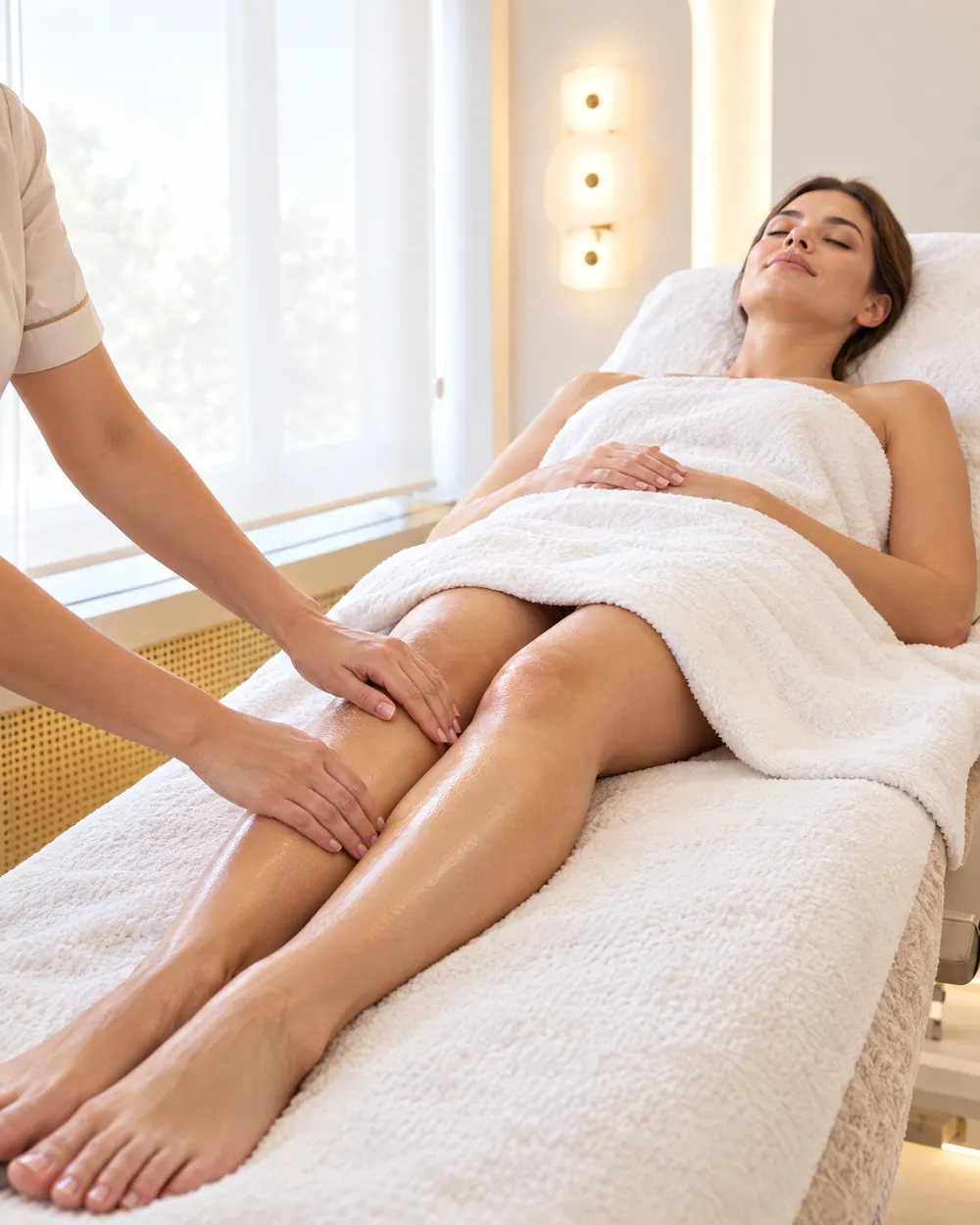
Lymphatic drainage massage is a technique that supports fluid flow just under the skin with light, rhythmic touch. On the legs, the movements are directed upward from the ankles toward the groin. A session lasts about 45 to 60 minutes, and one or two sessions a week can be planned as needed. After a long flight or a week spent on their feet, many people describe a clear feeling of lightness after a session.
It's important to set expectations clearly. Massage doesn't remove the inactivity, salt, or heat that causes evening heaviness; if your routine stays the same, the feeling returns after a while. Lymphatic drainage massage is done for beauty and relaxation. Medical edema or lymphedema needs follow-up from a doctor and physical therapist and is outside what a beauty center does. We cover the technique in detail in our post “What is lymphatic drainage massage? A guide to puffiness and feeling lighter.”
Does G5 Massage help with heavy legs?
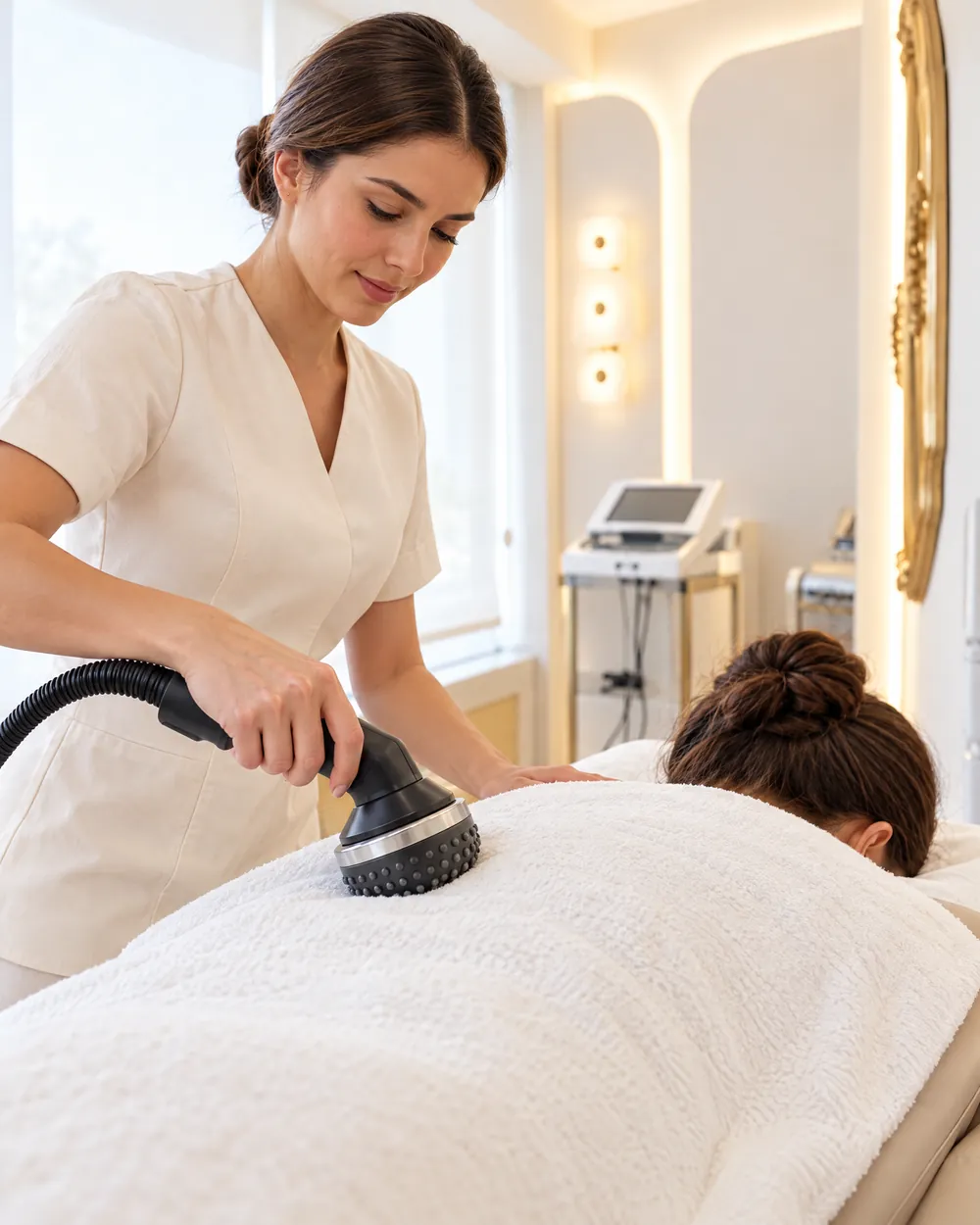
G5 is a deep tissue massage done with vibrating heads, and it aims to get circulation moving. Its main uses are the look of cellulite and firmness in specific areas, but many people with heavy legs say they walk more comfortably after a session. A session lasts about 30 to 45 minutes, and it is usually planned as a program of 10 to 12 sessions, two or three times a week.
G5 is a stronger stimulus than lymphatic drainage and isn't right for everyone. It is not applied to areas with varicose veins or vascular disease. For someone with clearly visible veins in the legs, the first step is not G5 but an assessment by a doctor. When heaviness and puffiness are the main concern, lymphatic drainage usually comes first; if the look of cellulite is also part of the picture, planning the two together is discussed at the consultation.
When is massage not done?
Because lymphatic drainage and G5 affect fluid movement and circulation in the body, in some situations they are not done, or are planned only with a doctor's approval. That's why we ask about your health history in detail at the consultation.
- Heart or kidney disease: Lymphatic drainage is not done without a doctor's approval.
- Suspected or past deep vein thrombosis (a blood clot): If a clot is suspected, no massage is done and you should see a doctor first. With a past clot, G5 is not done, and lymphatic drainage is not done without a doctor's approval.
- Active infection, fever, an open wound, or inflamed skin: No session is done.
- A cancer diagnosis or history of cancer: No session is done without a doctor's approval.
- Areas with varicose veins or vascular disease: G5 is not applied to these areas.
- Pregnancy: G5 is not done; lymphatic drainage requires a doctor's opinion.
- Recent surgery: A session is planned only with your doctor's approval.
- Taking blood thinners or bruising easily: Get a doctor's opinion before G5.
How your legs feel in the evening usually depends less on the massage table and more on how many times you got up during the day.
What are the common myths about heavy legs?
- “I work on my feet, so I move enough.” Standing still doesn't work the calf pump the way walking does.
- “If I drink less water, my legs will swell less.” Not drinking enough over the day can strain your fluid balance; cutting back on water is not the answer.
- “Only people who are overweight get this.” It can happen to anyone who sits or stands for long periods, whatever their weight.
- “The harder I rub, the better it works.” Hard rubbing is not recommended, especially over areas with visible veins; fluid flow is supported with light touch.
- “If I get massages, my habits don't matter.” Massage supports a feeling of lightness, but as long as inactivity continues, the heaviness comes back.
When should you see a doctor?
What this post describes is heaviness that is similar in both legs, builds in the evening, and eases overnight. The situations below don't fit that picture and need a doctor's assessment.
- Swelling that starts suddenly in one leg, especially with pain, redness, warmth, or tenderness in the calf. These can be signs of a blood clot (deep vein thrombosis); don't get a massage, and see a doctor the same day.
- If swelling in the leg comes with sudden shortness of breath, chest pain, a racing heart, or coughing up blood, call 112, the emergency number in Türkiye, right away.
- Swelling that doesn't go down by morning, gets worse every day, or leaves a dent that lasts when you press it with a finger.
- Prominent, bulging, or painful varicose veins, changes in skin color, hardening of the skin, or a sore that won't close.
- If you have heart, kidney, liver, or thyroid disease, or noticed swelling after starting a new medication.
- Sudden swelling in the hands, face, or legs during pregnancy; if it comes with a headache or blurred vision, contact your doctor or go to the emergency room right away.
Vega Beauty is a beauty and care center; we don't diagnose. At our center in Nişantaşı, we listen to your concerns and health history before planning lymphatic drainage or G5. If we notice a sign that needs a doctor's assessment, we postpone the session and refer you to a doctor.
Frequently asked questions
Why do my legs feel heavy in the evening?
The most common reason is staying in the same position for a long time. When you sit, or stand without moving, your calf muscles do little work and fluid returns from your legs more slowly. Salt, heat, high heels, and not drinking enough water can make the feeling stronger.
What can I do at home to ease heavy legs?
Getting up for a few minutes every hour, moving your ankles while seated, spreading your water across the day, and cutting back on salt are the first steps. Raising your legs above heart level for 10 to 15 minutes in the evening also brings a feeling of lightness for many people.
Does lymphatic drainage massage help with swollen-feeling legs?
Lymphatic drainage massage supports fluid flow with light, rhythmic touch and may help ease the feeling of heaviness and puffiness. A session lasts about 45 to 60 minutes, and one or two sessions a week are planned as needed. It doesn't remove causes such as inactivity, and it doesn't replace medical care for edema.
Can I get G5 Massage if I have varicose veins?
No. G5 is not applied to areas with varicose veins or vascular disease. If you have prominent varicose veins, a doctor's assessment comes first.
Is it normal for my legs to swell after a long flight?
Mild swelling and heaviness in both legs is common and usually goes down within a few hours with movement and rest. If the swelling is in one leg, or is painful, red, or warm, or comes with shortness of breath, it is not considered normal; see a doctor right away, and call 112 if you are short of breath.
When should leg swelling be checked by a doctor?
See a doctor if the swelling is in one leg and started suddenly, if it comes with pain, redness, or warmth, if it doesn't go down by morning and keeps getting worse, if you have heart, kidney, liver, or thyroid disease, or if you notice sudden swelling during pregnancy. In these situations, massage is not considered.
Published: · Vega Beauty editorial team. This article is general information and does not replace a medical diagnosis or advice; whether a service suits you is assessed at your consultation.